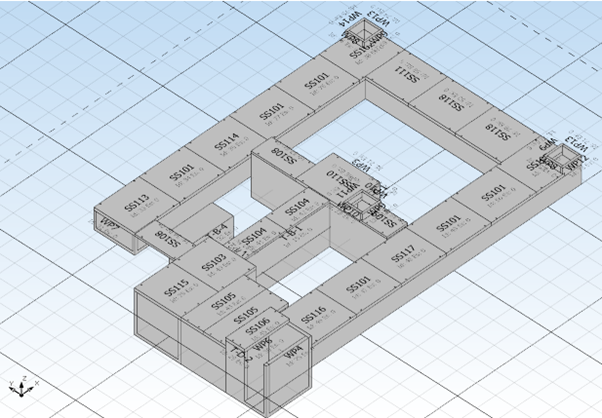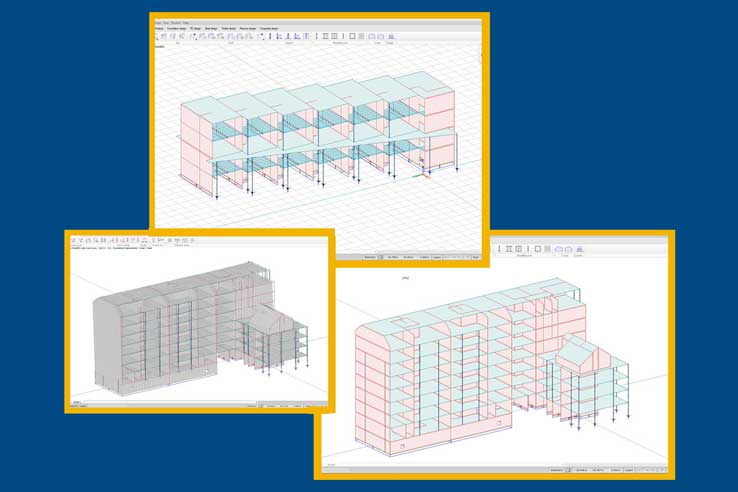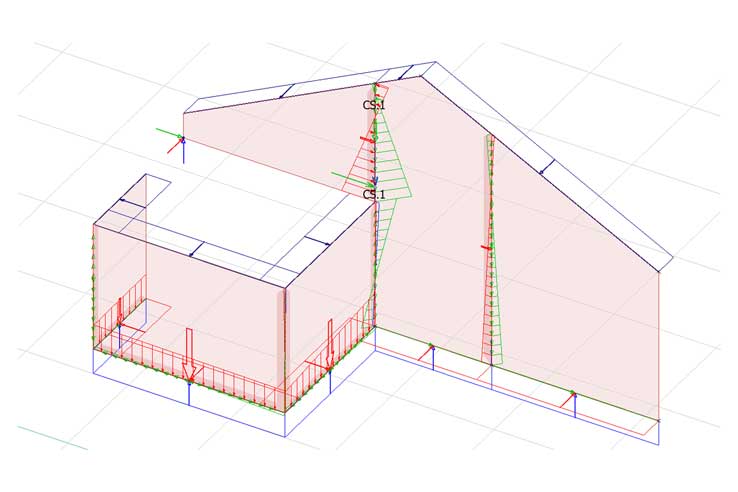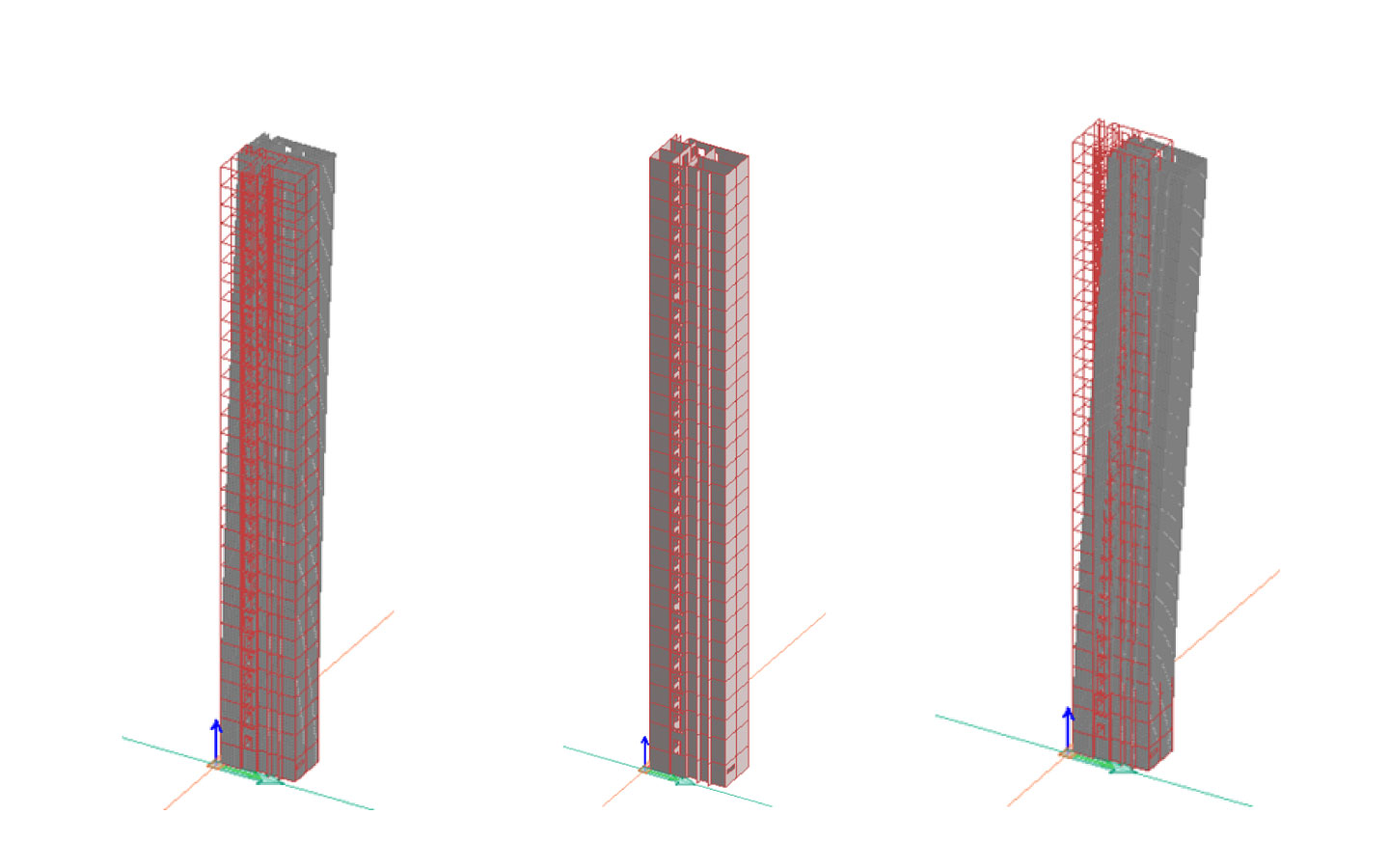
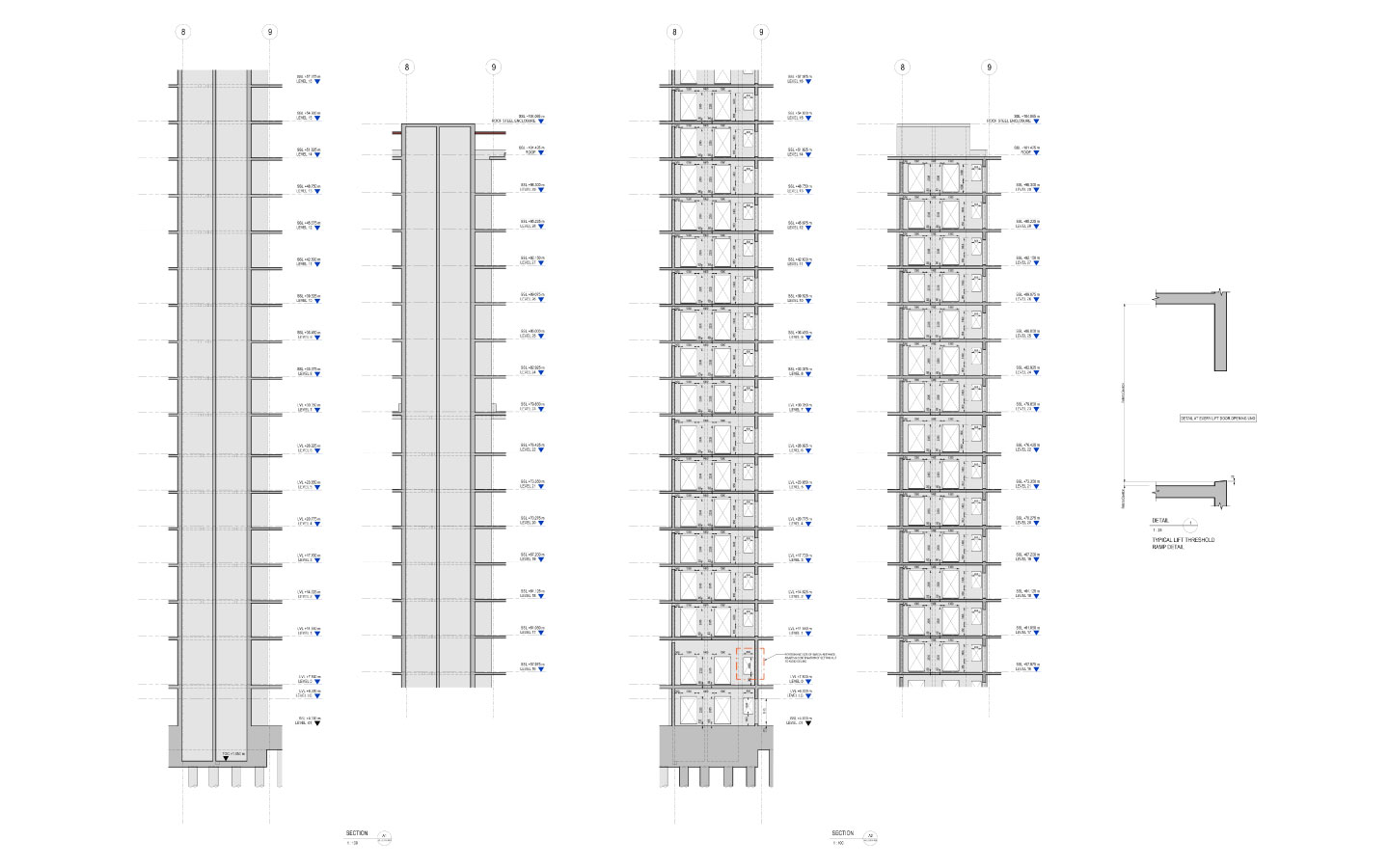
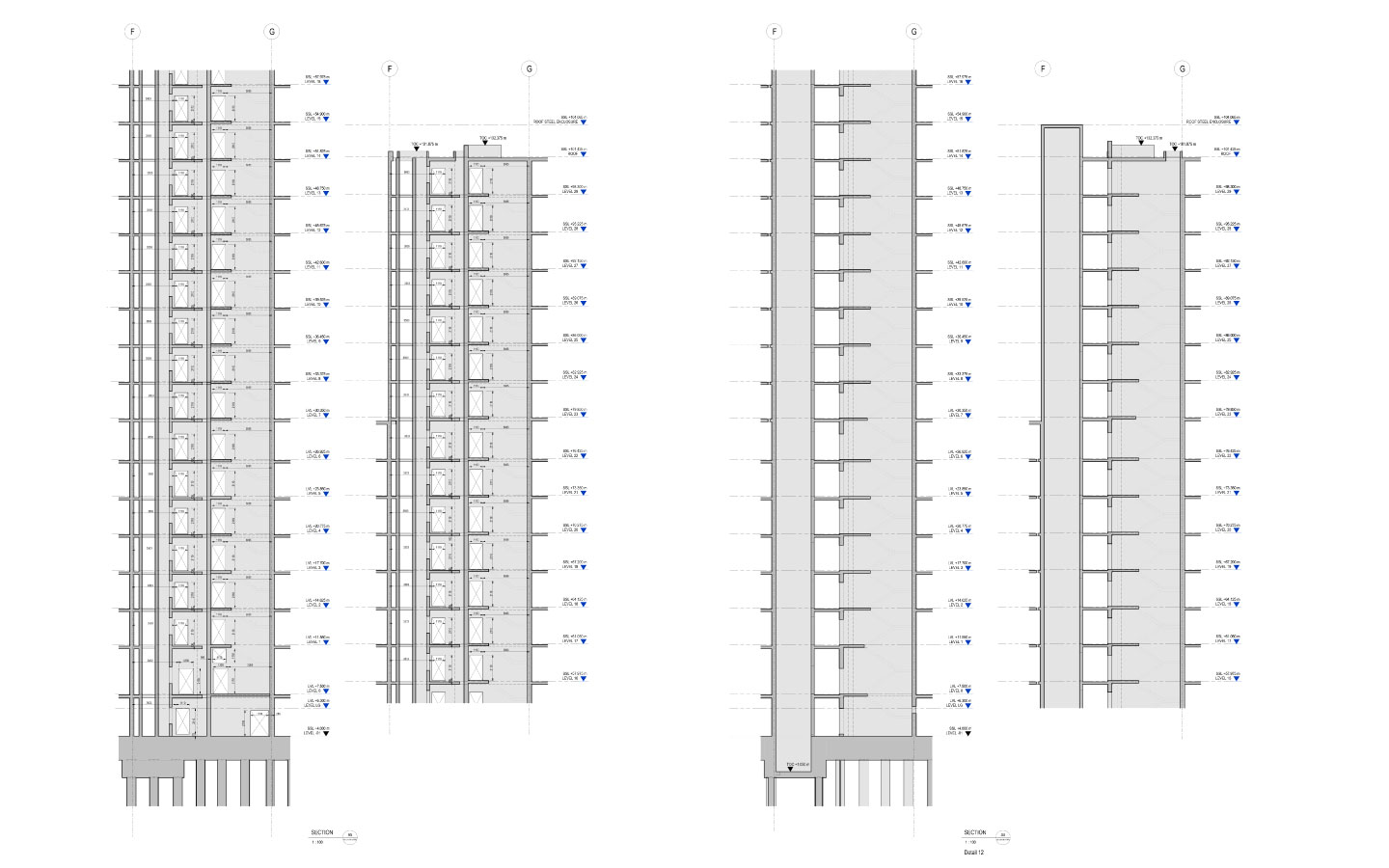
In high-rise construction, the structural core acts as the “spine” of the building. For the Greenwich Development, a 31-story tower standing at approximately 97.5 meters, ensuring the stability of this spine during the slip-forming phase was critical. This case study details the Finite Element Method (FEM) analysis conducted to validate the core’s performance under temporary construction loads, focusing on deflection limits, upward pressure, and reinforcement mapping.
Project Overview: The Greenwich Challenge
The Greenwich project is a significant vertical development comprising 31 slabs, including a Lower Ground (LG) floor, Ground floor, 29 upper stories, and a Terrace level.
The primary engineering challenge lay in the construction sequence. The core walls were designed to be constructed via slip forming—a method where the concrete core rises rapidly in advance of the floor slabs. This creates a temporary structural state where the core must stand independently at its full height of nearly 100 meters without the lateral bracing typically provided by floor plates.
Structural Specifications
- Total Height: ~97.5m
- Total Levels: 31
- Construction Method: Slip forming (Advanced Core)
- Analysis Focus: Core stability from LG to 29th Floor
Technical Methodology: FEM Design & Modeling
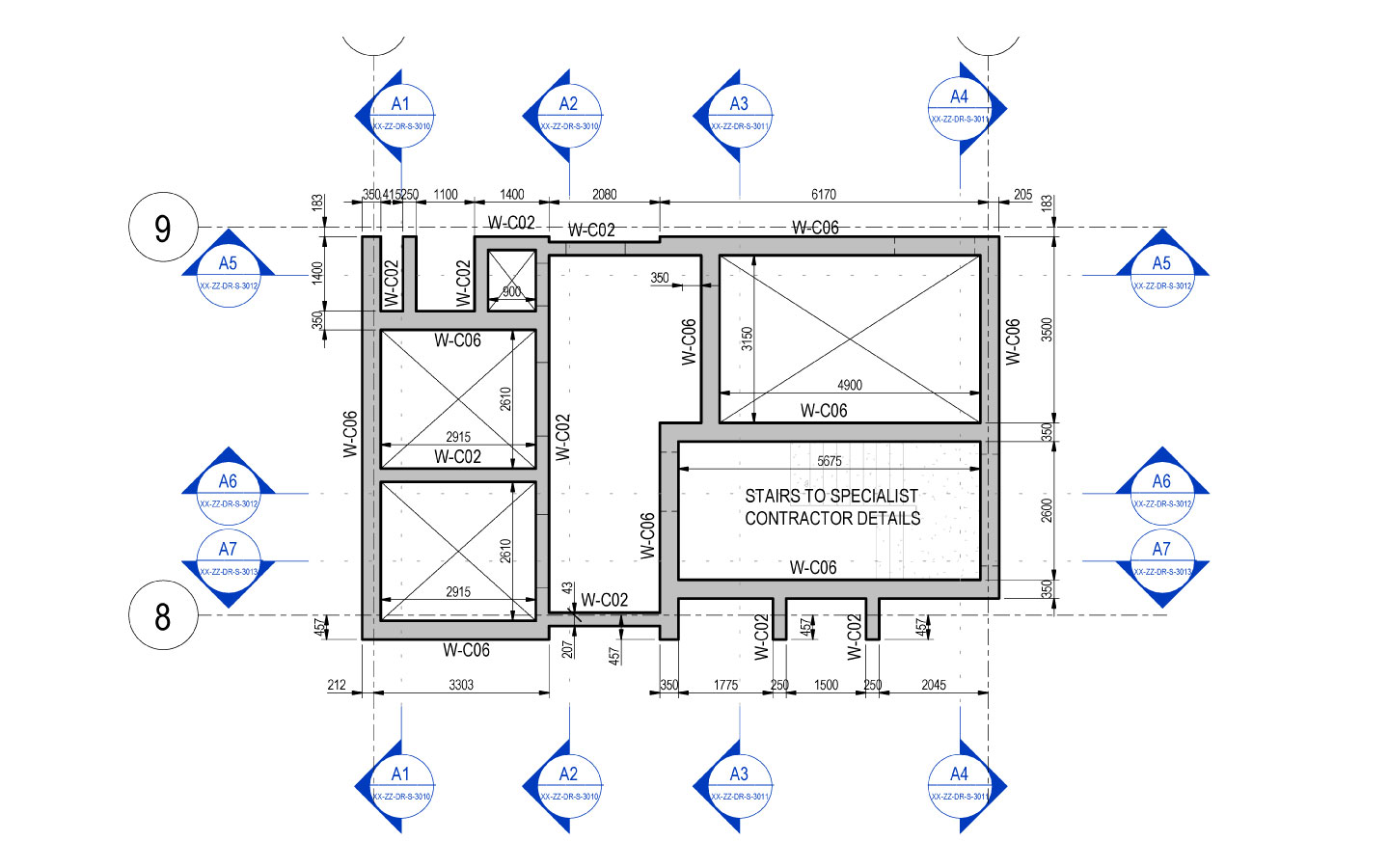
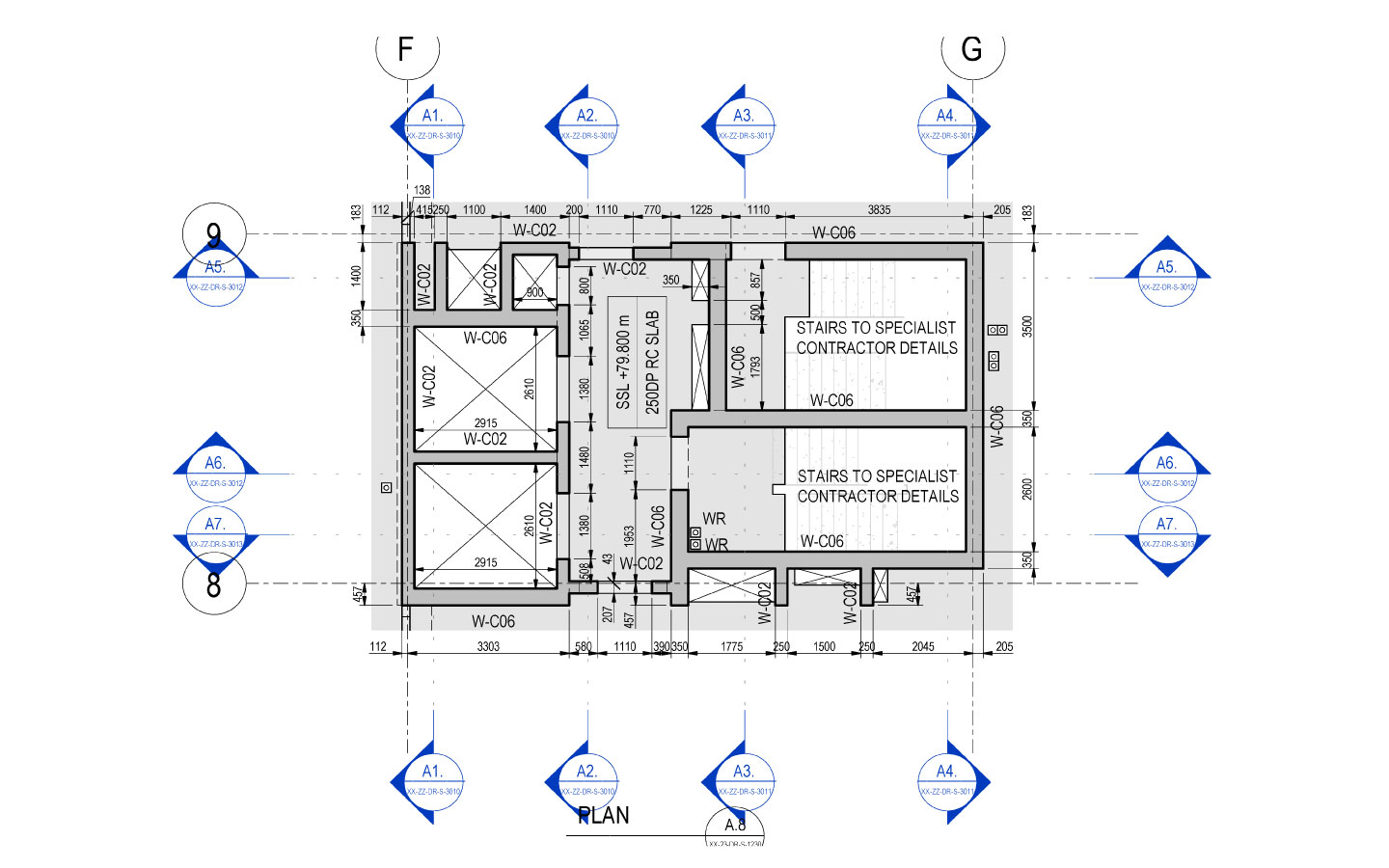
To ensure the highest level of accuracy, our team utilized FEM Design software to create a high-fidelity digital twin of the Greenwich core.
The “Worst-Case” Simulation
Our analysis was intentionally conservative. We modeled the core as a fully constructed standalone unit at its maximum height before the integration of any floor slabs. This approach accounts for the most volatile period of the construction lifecycle, where wind loads and self-weight are at their most impactful.
Key Parameters Evaluated:
- Deflection Analysis: Measuring lateral sway in both X and Y directions.
- Upward Pressure (Uplift): Checking for foundation or joint separation under extreme load combinations.
- Reinforcement Mapping: Determining the exact steel requirements to handle temporary construction stresses.
Performance Results & Validation
1. Lateral Deflection Limits
In high-rise engineering, excessive sway can lead to structural fatigue or failure of the slip-form equipment. We applied the industry-standard H/500 permissible deflection limit.
- Height (H): 97,500 mm
- Permissible Limit: $frac = 195text$
Our FEM results confirmed that the deflections in both the X and Y directions remained well within these tolerances. Even with the conservative "standalone" modeling approach, the structural stiffness of the Greenwich core exceeded safety requirements.
2. Uplift and Upward Pressure
A critical concern for slender, tall cores is the possibility of uplift on the windward side during high-wind events during construction. Our analysis rigorously checked all specified load combinations.
- Finding: No uplift was encountered. The self-weight of the reinforced concrete and the foundation design provided a sufficient factor of safety against overturning moments.
3. Reinforcement Requirements
Using the FEM data, we generated comprehensive Reinforcement Maps. These maps provide a visual and data-driven guide for the placement of vertical and horizontal rebar, specifically optimized for temporary construction load cases.
Strategic Outcomes
By conducting this advanced stability work, our team provided the client with three vital “safety pillars”:
- Validation of Method: Proved that slip-forming the core to full height in advance was a safe and viable construction strategy.
- Conservative Assurance: By proving stability without the floor slabs, we ensured that the final, completed building would have an even higher safety margin.
- Optimized Material Use: The reinforcement maps allowed for precise steel placement, preventing over-engineering while ensuring total compliance with structural codes.
Conclusion
The Greenwich core stability project highlights the necessity of advanced FEM analysis in modern high-rise construction. Through meticulous modeling and a “safety-first” conservative approach, we successfully navigated the complexities of a 97.5m slip-formed structure, ensuring a stable foundation for the rest of the development to follow.
Let’s Build the Future Together
Are you planning a high-rise development with complex construction sequences? Our team specializes in core stability and FEM analysis to ensure your project stands tall.